


Businesses and public organisations have more information to communicate than ever before.
A bank may need to display changing information. A railway station needs to communicate passenger information. A factory may need to show production data. A retail business may want to highlight promotions. A school, hospital or office may need to display announcements.
Traditional signs can communicate a fixed message, but they become less practical when the information changes regularly.
This is where an LED display board can provide a more flexible communication solution.
An LED display board can present text, numbers, messages and other visual information in a format that is easy to update. Depending on its configuration, it can be designed for indoor or outdoor use, single-line or multi-line communication, and different colour requirements.
But choosing an LED display board should begin with the information you need to communicate—not simply with the size or appearance of the board.
What Is an LED Display Board?
An LED display board is an electronic display system that uses light-emitting diodes to present visual information.
Depending on the application, an LED display board can be used to show:
- Text messages
- Numbers
- Announcements
- News
- Promotional messages
- Arrival and departure information
- Production information
- Interest rates
- Scores
- Safety information
- Directional information
Unlike a conventional printed sign, the content can be changed electronically.
This makes LED display boards useful in environments where information needs to be updated regularly.
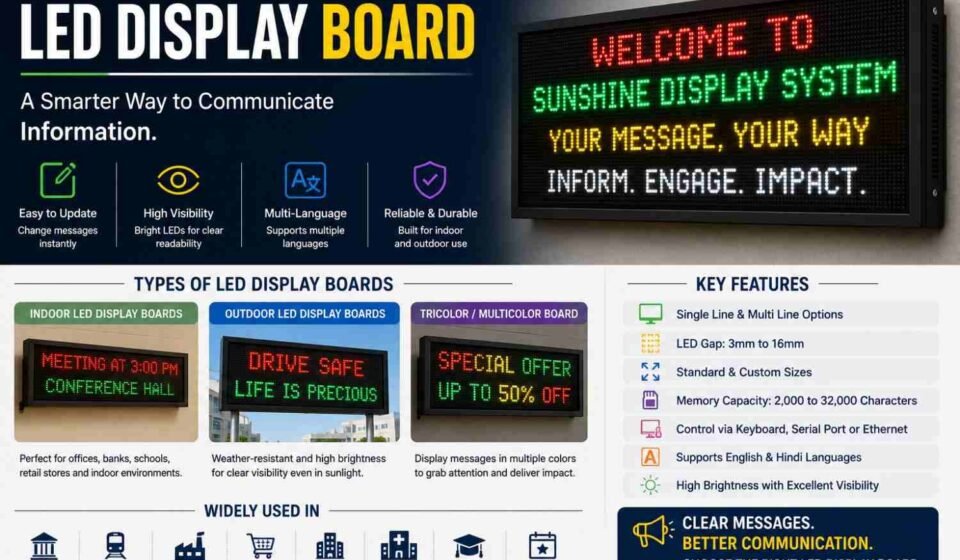
Sunshine Display System offers LED display boards in different configurations, including indoor, outdoor, tricolor and multicolor models.
Why Businesses and Organisations Use LED Display Boards
The value of an LED display board is not simply that it lights up.
Its real advantage is the ability to communicate changing information in a visible and reusable format.
Consider a bank.
A printed sign might permanently display the bank’s name and services. But information such as interest rates, announcements or promotional messages may change.
An LED display board can provide a dedicated space for changing information without requiring a new physical sign each time.
The same principle applies to railway stations, factories, shops, offices, schools, event venues and other locations.
- Information Can Be Updated
One of the most useful characteristics of an LED display board is programmable content.
Sunshine Display System’s LED display board configurations support message entry and editing through a keyboard, while PC interfaces can be provided through customised software using serial port or Ethernet connectivity.
This gives organisations different ways to manage the information shown on the board depending on the system configuration.
For a business with frequently changing messages, this flexibility can be much more useful than repeatedly producing new printed signage.
- LED Display Boards Can Show Text and Numbers
Not every digital display application requires full-motion video.
Many organisations simply need clear communication of text and numerical information.
Examples include:
- Bank rate displays
- Token numbers
- Production counts
- Arrival information
- Departure information
- Scores
- Safety statistics
- Public announcements
- Queue information
- Price information
For these applications, a dedicated LED display board can be a practical alternative to a larger video display.
The required configuration should depend on the type and amount of information being displayed.
- Single-Line and Multi-Line LED Display Boards
The amount of information you need to communicate also affects the board design.
A single-line LED display may be sufficient for a short message such as:
WELCOME TO OUR STORE
A multi-line display can communicate considerably more information at the same time.
For example:
TODAY’S ANNOUNCEMENT
MEETING STARTS AT 3:00 PM
CONFERENCE HALL – SECOND FLOOR
Sunshine Display System lists both single-line and multi-line options for its LED display board configurations.
The right format therefore depends on how much information viewers need to read at once.
Indoor vs Outdoor LED Display Boards
One of the first decisions when specifying an LED display board is whether it will be installed indoors or outdoors.
The two environments have different requirements.
Indoor LED Display Board
Indoor boards operate in relatively controlled environments.
They can be suitable for:
- Offices
- Banks
- Retail stores
- Reception areas
- Meeting spaces
- Institutions
- Indoor public areas
- Commercial buildings
Sunshine Display System’s indoor LED display board range includes standard and made-to-order sizes, LED gaps from 3 mm to 16 mm, single-line and multi-line configurations, and text and numeric display capabilities.
Indoor applications should still be evaluated according to viewing distance, ambient lighting and the type of information being displayed.
Outdoor LED Display Board
Outdoor installations have additional environmental considerations.
The display may need to remain readable during daylight and operate in conditions involving dust, wind, moisture and temperature changes.
Sunshine Display System lists high-brightness LEDs for its outdoor display board configurations and specifies clear daytime visibility. Its outdoor boards are available in standard and made-to-order sizes.
For an outdoor project, the display should be evaluated together with the mounting structure, electrical installation and environmental requirements.
Tricolor vs Multicolor LED Display Boards
Colour is another consideration.
Not every application requires a full-colour video display.
Tricolor LED Display Board
A tricolor LED display board can show information in one, two or three colours.
This can be useful where colour is needed to distinguish different types of information while keeping the display relatively simple.
Sunshine Display System lists tricolor configurations with:
- Standard and made-to-order sizes
- LED gaps from 3 mm to 16 mm
- Single-line and multi-line formats
- Text and numeric display
- English and Hindi language support
- High-brightness LEDs
- Daytime visibility
Multicolor LED Display Board
A multicolor LED display board provides a broader range of colours for applications where more visual variation is required.
Sunshine Display System lists multicolor boards with standard and made-to-order sizes, 3–16 mm LED gaps, single-line and multi-line options, English and Hindi language support, and text and numeric display.
The choice between tricolor and multicolor should therefore be based on the content requirements rather than simply choosing the option with more colours.
How to Choose the Right LED Display Board
Buying an LED display board without first defining the application can lead to the wrong configuration.
Start with these questions.
- What information will you display?
Will the board show:
- Short messages?
- Numbers?
- Prices?
- Announcements?
- Production data?
- Public information?
- Advertising content?
The answer determines the type of display you need.
- Where will the board be installed?
Indoor and outdoor environments have different requirements.
- How far away will viewers be?
Viewing distance should be considered when selecting LED gap or pixel pitch.
A display viewed from several metres away does not necessarily need the same specification as one viewed from close range.
- How much text needs to appear?
A single-line message requires a different layout from a board that needs to show several lines of information simultaneously.
- Do you need multiple colours?
For straightforward text communication, a single-colour or tricolor system may be sufficient.
If visual differentiation is important, a multicolor configuration may be more suitable.
- How will the content be updated?
Ask whether the display will be controlled through a keyboard, computer, serial connection, Ethernet or another system.
LED Gap and Why It Matters
One specification that frequently appears in LED display board quotations is LED gap, also commonly discussed as pixel pitch.
It refers to the distance between individual LED pixels.
A smaller gap places pixels closer together, while a larger gap spaces them farther apart.
The appropriate selection depends on factors such as:
- Viewing distance
- Required readability
- Display size
- Content type
- Installation environment
Sunshine Display System lists LED gap options from 3 mm to 16 mm across its LED display board configurations.
Instead of automatically choosing the smallest available gap, buyers should first determine how close the audience will be to the display.
Display Size Should Match the Application
An LED display board does not have to be a huge advertising screen.
A small information board may be appropriate for a reception desk or shop counter, while a much larger display may be needed for a railway station, factory floor or outdoor location.
Sunshine Display System states that its LED display boards are available in standard as well as made-to-order sizes. The published range begins at 6 × 12 inches for its indoor and outdoor configurations, while tricolor and multicolor options start at 3 × 12 inches, with custom sizing available.
This is important because the display should be designed around the communication requirement and available installation space.
How Much Information Can an LED Display Board Store?
Content capacity is another specification worth discussing with the manufacturer.
Sunshine Display System lists memory capacities from 2,000 to 32,000 characters for its indoor, outdoor, tricolor and multicolor LED display board configurations.
The appropriate capacity depends on how many messages need to be stored and how the system will be operated.
A small sign displaying a short recurring message may have very different requirements from a public-information board containing multiple messages.
Where Are LED Display Boards Used?
The applications are much broader than advertising.
Banks
LED boards can be used for rates, announcements, token information and customer communication.
Railway Stations
Electronic boards can communicate arrival, departure and other passenger information.
Factories
Production display boards can communicate operational information, targets and production status.
Sunshine Display System separately offers production display boards designed to show processing information and production-related data.
Retail Stores
Retailers can use LED boards for promotions, announcements and customer-facing information.
Offices
LED display boards can communicate announcements, meeting information or other changing messages.
Hospitals
Digital boards can assist with information and communication in appropriate areas.
Educational Institutions
Schools, colleges and training centres can use digital displays for notices, schedules and announcements.
Events
LED boards can communicate event information, schedules and other messages.
Public Information
Government and public organisations can use digital displays for changing information and announcements.
LED Display Boards for Industrial Communication
Industrial environments have different communication requirements from retail advertising.
A factory may need to display:
- Production targets
- Shift information
- Current production
- Break timings
- Safety information
- Performance data
A static board becomes difficult to manage when the information changes throughout the working day.
Purpose-built LED production display systems can receive information from software or input devices and present it in a highly visible format.
Sunshine Display System’s production display boards, for example, are designed for production information and can accept data through an LCD keypad or customised computer software via serial communication.
This illustrates an important point:
An LED display board is not necessarily an advertising product. It can also be an operational communication tool.
LED Display Board vs Conventional Signage
A conventional printed sign is useful when information remains relatively permanent.
An LED display board becomes more valuable when information changes.
| Requirement | Static Signage | LED Display Board |
| Permanent information | Suitable | Suitable |
| Frequently changing messages | Less flexible | Suitable |
| Text updates | Requires new signage | Programmable |
| Multiple messages | Limited | Supported |
| Numerical information | Static | Dynamic |
| Colour options | Fixed design | Configurable by model |
| Single-line messages | Possible | Supported |
| Multi-line messages | Possible | Supported |
| Outdoor visibility | Depends on signage | Outdoor high-brightness options available |
The choice should depend on the purpose of the sign rather than assuming that digital technology is always the better solution.
What Should You Ask an LED Display Board Manufacturer?
Before ordering, ask for a clear technical specification.
Application
What will the display be used for?
Environment
Is it intended for indoor or outdoor installation?
Size
What are the exact physical dimensions?
LED Gap
What LED gap is recommended for the viewing distance?
Lines
Is it a single-line or multi-line system?
Colour
Is a single-colour, tricolor or multicolor display appropriate?
Content
What type of information can the system display?
Memory
How much message storage is available?
Connectivity
How will the board receive updated information?
Maintenance
How are components accessed and replaced?
Customisation
Can the manufacturer build the display according to the required dimensions and communication requirements?
Getting these answers before purchasing makes it easier to compare different suppliers.
Why Customisation Can Matter
There is no single LED display board that is ideal for every environment.
A small bank information display has different requirements from a factory production board.
A railway information display has different requirements from a retail promotional board.
An outdoor public-information board has different requirements from an indoor office display.
This is why custom sizing, LED gap, colour configuration, line configuration and communication methods can be important.
Sunshine Display System states that it provides both standard and made-to-order LED display board sizes and offers different configurations for indoor, outdoor, tricolor and multicolor applications.
A Practical Checklist Before Buying an LED Display Board
Before placing an order, prepare the following information:
☐ Intended application
☐ Indoor or outdoor location
☐ Available installation space
☐ Approximate viewing distance
☐ Required display size
☐ Single-line or multi-line requirement
☐ Text or numerical information
☐ Required colours
☐ Required language
☐ Content-update method
☐ Required memory capacity
☐ Connectivity requirements
☐ Maintenance access
☐ Installation requirements
This information gives the manufacturer a much clearer understanding of the project.
The Right LED Display Board Starts With the Right Question
When businesses search for an LED display board, it is tempting to begin by asking:
“How much does it cost?”
A better first question is:
“What information do I need the display to communicate?”
Once the purpose is clear, the other decisions become easier.
You can determine whether you need an indoor or outdoor model, single-line or multi-line format, tricolor or multicolor display, the appropriate LED gap, the required size and the best way to update content.
That approach can help businesses avoid paying for specifications they do not need while ensuring that the final display performs the intended communication function.
For organisations looking for a customised solution, LED display board options from Sunshine Display System include indoor, outdoor, tricolor and multicolor configurations with standard and made-to-order sizes.
The best LED display board is not necessarily the biggest or most advanced one.
It is the one specified correctly for the information, environment and audience it is intended to serve.